Best overall: a final pre-closing inspection. Best specialty add-on: radon testing. Best before walls close: a pre-drywall inspection. For Knoxville buyers comparing inspections for new construction homes in 2026, the right combination depends on the construction stage, accessible systems and questions that remain unanswered.
- For inspections for new construction homes Knoxville buyers need, prioritize a final pre-closing inspection.
- Mycityhomeinspector offers residential inspections and specialty testing in Knoxville; confirm the scope needed for your construction stage.
- Add radon testing for a measured result; new construction alone does not establish indoor radon levels.
- Choose pre-drywall, sewer scope or mold assessment when the construction stage or property conditions support them.
Mycityhomeinspector is a fit for Knoxville buyers seeking residential inspections and specialty testing. Review the available inspection services and confirm which inspections cover your building stage before scheduling.
Why new construction still needs inspection
New construction describes the property's age, not the condition of every installed component. A buyer's inspection documents visible and accessible conditions, identifies limitations and gives you findings to discuss with the builder.
Keep the roles separate. An inspection does not replace municipal approvals, builder quality-control checks or specialist evaluation when a finding requires it. Testing answers a defined question; repair or remediation addresses the condition found.
This guide focuses on Knoxville. Mycityhomeinspector also serves Chattanooga, Nashville and Atlanta, but this ranking does not assume identical local requirements across those markets.
What makes the best new-construction inspection
Choose your 2026 inspection plan using these criteria rather than ordering every test:
- Construction stage: Match the inspection to what remains visible before finishes conceal it.
- Scope: Confirm which systems, areas and tests the agreement includes.
- Access: Ask how locked rooms, unfinished work or inaccessible areas affect the report.
- Evidence: Look for clear observations, location-specific photos and understandable recommendations.
- Decision value: Favor inspections that answer a question you need resolved before closing or another contractual deadline.
- Follow-up: Know who evaluates a finding and how completed work will be documented.
A broad inspection and a specialty test serve different purposes. A report can describe an accessible plumbing condition; a sewer camera examines the accessible interior of a drain line. Neither automatically includes the other.
Best new-construction inspections at a glance
| Rank and inspection | Best for | Standout purpose | Key limitation |
|---|---|---|---|
| 1. Final pre-closing inspection | Buyers approaching completion | Reviews accessible systems and visible conditions | Does not expose concealed work |
| 2. Radon testing | Buyers seeking an indoor radon measurement | Produces a measured result under defined conditions | A short test does not describe every future condition |
| 3. Pre-drywall inspection | Buyers whose walls remain open | Documents accessible framing and rough-in conditions | Timing and builder access determine what is visible |
| 4. Sewer scope inspection | Buyers seeking drain-line evidence | Records the accessible interior of the sewer line | Access and camera travel limit coverage |
| 5. Pre-warranty inspection | Owners with a documented warranty deadline | Organizes observable concerns after occupancy | Warranty coverage depends on the written terms |
| 6. Targeted mold assessment | Buyers with moisture concerns | Investigates a defined moisture or mold question | Testing alone does not repair the moisture source |
These are inspection categories, not a claim that every provider offers every construction-phase service. Confirm availability, scope and reporting before choosing an appointment.
1. Final pre-closing inspection: best for overall coverage
A final pre-closing inspection is the default choice when the home is substantially complete and its systems can be evaluated. It reviews visible, accessible conditions across the agreed scope rather than concentrating on a single concern.
For a 2026 purchase, ask whether utilities, installed fixtures and access will be ready for the appointment. An unfinished or inaccessible component leaves a question open; the report should identify that limitation rather than imply the component passed.
Final pre-closing inspection pros:
- Covers a broader range of property conditions than a single specialty test.
- Creates a written record for builder discussions.
- Helps separate observed defects from items needing further evaluation.
Final pre-closing inspection cons:
- Cannot reveal all conditions behind completed walls or finishes.
- Incomplete construction can prevent evaluation of some components.
Best for: Buyers who need an overall condition report before closing.
Send documented findings to the builder through your agreed process. Ask how incomplete items and reported corrections will be checked, rather than treating a verbal assurance as closure.
Verdict: Buy as the foundation of your inspection plan.
2. Radon testing: best for a measured indoor-air result
Radon testing measures a condition that a visual inspection cannot establish. A newly built home, an attractive basement or a builder-installed pipe does not establish the home's indoor radon level.
The U.S. Environmental Protection Agency recommends fixing homes with radon levels at or above 4 pCi/L. Its short-term testing guidance includes tests lasting 2 to 90 days, depending on the device; follow the selected test's instructions and required building conditions.
Radon testing pros:
- Answers a specific question with a measured result.
- Adds information beyond a visual property inspection.
- Supports a defined discussion about follow-up testing or mitigation.
Radon testing cons:
- Results reflect the test period and conditions.
- Testing does not install, repair or verify every aspect of a mitigation system.
Best for: Buyers who want evidence about indoor radon rather than assumptions based on construction age.
Ask who interprets the result and what follow-up applies if the test conditions were not maintained. Keep the complete report, not only the headline reading.
Verdict: Buy as a separate measurement, not a substitute for inspection.
3. Pre-drywall inspection: best before work becomes concealed
A pre-drywall inspection reviews accessible construction before wall coverings conceal framing and rough-in work. Its value comes from timing: the same area cannot be viewed in the same way after finishes cover it.
Confirm the intended stage with both the builder and inspector. Scheduling too early leaves work unfinished; scheduling after insulation or coverings are installed changes what remains visible. Do not assume the appointment includes engineering analysis or code enforcement.
Pre-drywall inspection pros:
- Documents accessible work before concealment.
- Gives you location-specific findings to raise during construction.
- Complements rather than duplicates the final inspection.
Pre-drywall inspection cons:
- Depends on builder permission and construction timing.
- Cannot evaluate the completed operation of systems that remain unfinished.
Best for: Buyers who still have an opportunity to inspect open construction.
Request photos that identify the room or area clearly. A close-up without context is harder to connect to the correct location after walls are finished.
Verdict: Buy when the construction stage and access support it.
4. Sewer scope inspection: best for drain-line visibility
A sewer scope uses a camera to view the accessible interior of a sewer line. It answers a different question from operating indoor plumbing fixtures during a general inspection.
Ask where the camera will enter, which line segment the inspection intends to cover and how any incomplete coverage will be reported. A camera recording needs interpretation; an image alone does not establish the repair method or responsibility.
Sewer scope inspection pros:
- Provides visual evidence from an otherwise concealed line.
- Can document observable obstructions or other visible concerns.
- Helps direct follow-up to the relevant plumbing professional.
Sewer scope inspection cons:
- Camera travel and available access limit the inspection.
- Does not establish the condition of every buried connection or surrounding soil.
Best for: Buyers who want direct evidence about the accessible sewer-line interior.
Keep the recording with the written findings when one is provided. If a concern requires repair, ask the appropriate contractor to define the work rather than interpreting camera footage yourself.
Verdict: Buy when you need drain-line evidence beyond fixture operation.
5. Pre-warranty inspection: best before a documented deadline
A pre-warranty inspection documents observable conditions after you have lived in the home and before a relevant warranty deadline. It is a later checkpoint, not a replacement for a pre-closing inspection.
For a home purchased in 2026, use the actual warranty documents to establish dates, notice procedures and exclusions. Do not assume a standard anniversary or that an inspection report automatically creates an accepted claim.
Pre-warranty inspection pros:
- Gives you an organized record of current observable concerns.
- Lets you pair your occupancy observations with inspection findings.
- Supports clearer written communication with the builder.
Pre-warranty inspection cons:
- Does not determine whether the builder must cover an item.
- Cannot recreate conditions that existed before concealed work was completed.
Best for: Owners with written warranty terms and time to submit concerns properly.
Keep a running record of locations, dates and conditions when you notice a problem. Share that history without presenting an unverified diagnosis as fact.
Verdict: Buy when a documented deadline makes a later inspection actionable.
6. Targeted mold assessment: best for a moisture concern
A targeted mold assessment addresses a defined concern, such as visible suspect growth, a moisture history or an unexplained odor. It should begin with the question being investigated, not an automatic decision to collect samples.
Ask what the assessment includes and what any proposed sampling can establish. A laboratory result does not repair a leak, dry concealed materials or establish the condition of every room and cavity.
Targeted mold assessment pros:
- Focuses attention on a specific moisture-related concern.
- Can combine observations with appropriately selected testing.
- Helps define questions for further evaluation or remediation.
Targeted mold assessment cons:
- Samples have limits and require interpretation.
- Assessment and testing do not remove growth or correct water entry.
Best for: Buyers with an identified concern that needs a focused investigation.
For an unexplained stain, document the location and ask whether the source has been identified. Covering a mark does not answer why it appeared.
Verdict: Hold unless a defined concern supports the assessment.
Radon results and builder questions
Keep the distinction between construction features and measured performance clear. Discussions about radon mitigation in new construction need to separate installed components from the test result; Michigan-specific construction information does not establish Knoxville requirements.
If a builder identifies a radon-related feature, ask what was installed, whether it is passive or active and what documentation exists. Then ask how indoor radon will be measured under appropriate test conditions.
The EPA's 4 pCi/L action level concerns a measured concentration. It is not a visual inspection standard or proof that any particular pipe installation is performing as intended. Keep testing, system evaluation and corrective work as separate decisions.
Turn inspection findings into next steps
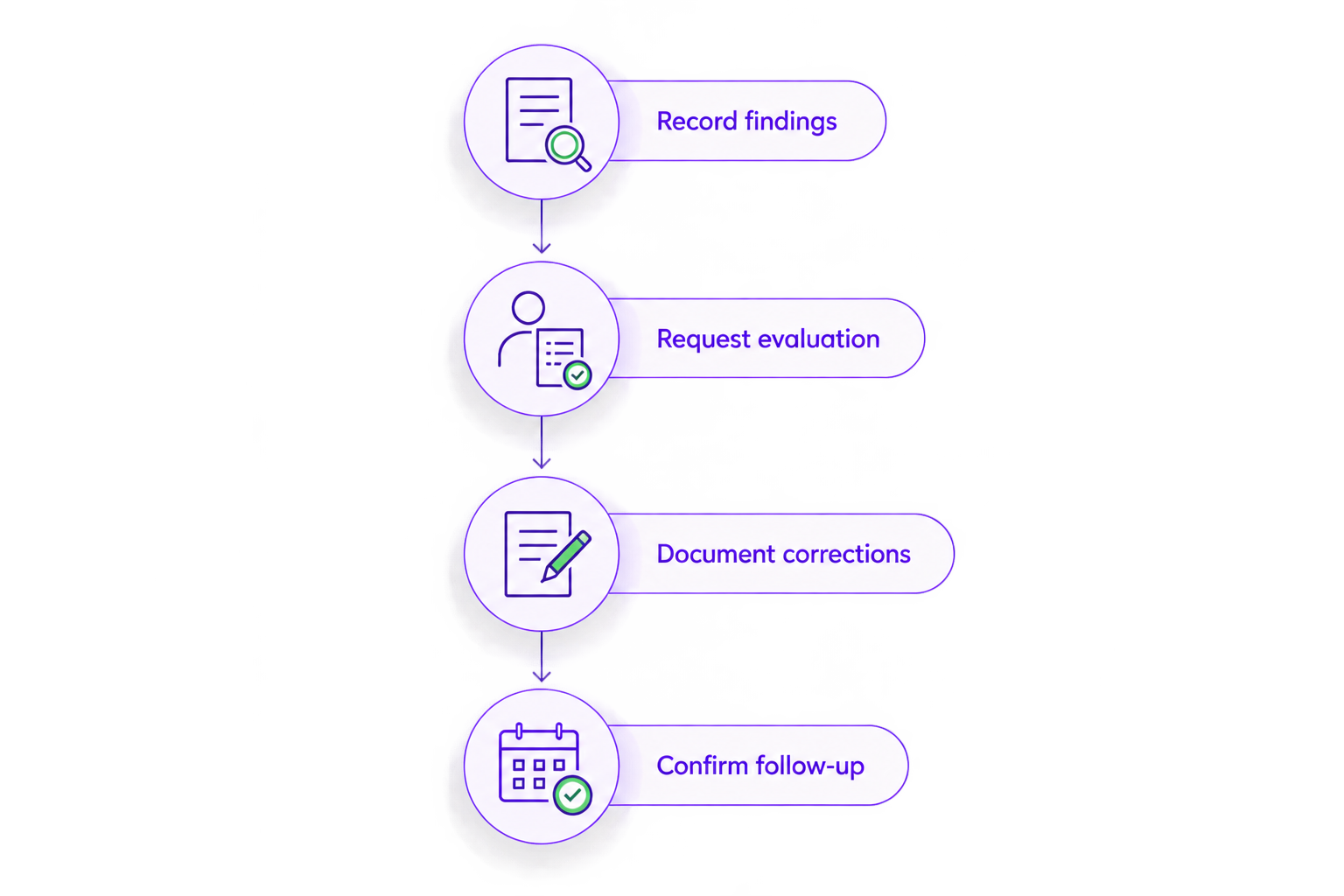
A report helps when each finding leads to a clear action. Use the same process for a general inspection and specialty testing:
- Record findings: Keep the location, observation, photos and stated limitation together.
- Request evaluation: Send technical questions to the appropriate qualified professional.
- Document corrections: Ask what work was completed and retain supporting records.
- Confirm follow-up: Establish whether another inspection, test or specialist review is needed.
Do not erase an unresolved concern from your list because the builder has acknowledged it. Acknowledgment, completed work and verification are different stages. Your contract and professional advisers determine how those stages affect closing.
How these inspections are ranked
This 2026 ranking prioritizes breadth first, then questions that need separate measurements or access. That puts the final inspection first, radon testing next and construction-stage or condition-specific inspections in distinct roles.
It does not rank providers, promise defect detection or assume every home needs every add-on. The strongest plan matches the inspection scope to the decision you need to make.
Which inspections should you choose?
Start with a final pre-closing inspection, then add radon testing and any stage-specific inspection that answers an unresolved question. If the walls remain open, discuss pre-drywall timing before that opportunity passes.
Mycityhomeinspector offers residential inspections and specialty services including radon, mold and sewer scope testing. Confirm the applicable scope and construction-stage services directly; the category ranking above does not replace a service agreement.
FAQ
What's the best inspection for a new construction home in Knoxville?
A final pre-closing inspection is the best starting point for broad coverage of visible and accessible conditions. Add specialty testing or construction-stage inspections to answer questions outside that scope.
Do I need an inspection if the builder already inspected the house?
A buyer's inspection serves a separate purpose from the builder's checks. It gives you a report of observed conditions and limitations within the agreed inspection scope.
Should I test a newly built Knoxville home for radon?
Radon testing provides a measured result that construction age cannot establish. Follow the selected test's instructions and discuss the result and any follow-up with the testing professional.
Is a pre-drywall inspection better than a final inspection?
Neither replaces the other because they examine different construction stages. A pre-drywall inspection documents accessible unfinished work, while a final inspection evaluates the substantially completed home within its scope.
Does a home inspection automatically include a sewer scope?
Do not assume a sewer scope is included in a general home inspection. Confirm the agreement, access requirements, intended coverage and reporting before scheduling.
Should every new construction home get mold testing?
Mold testing should answer a defined question rather than serve as an automatic add-on. Discuss visible concerns, odors or moisture history so the professional can explain the appropriate assessment and its limits.
Can an inspection report make the builder repair everything?
An inspection report documents findings; it does not determine the builder's contractual obligations. Use your purchase agreement, warranty terms and professional advice to establish notice procedures and next steps.
One last thing
Ask which parts of the home could not be inspected, not just which defects were found. An inaccessible area is an unanswered question, not a clean result. Before closing, decide how each important limitation will be resolved or documented.
Related guides
- Home inspection cost in Knoxville
- Specialty tests for an older home purchase in Knoxville
- Specialty tests for an older home purchase in Chattanooga
- Specialty tests for an older home purchase in Nashville
Protect Your Home. Inside and Out.
Plan a professional inspection and get clearer information about the property you own, are buying, or are preparing to sell.