Best overall starting add-on: radon testing. Best for underground drain condition: a sewer scope. Best for wood-damage concerns: termite inspection. For specialty tests for older homes in Chattanooga, choose additional lead, asbestos or mold assessment around the property's materials, condition and planned work—not age alone. Mycityhomeinspector is a fit for Chattanooga buyers seeking home inspections and specialty testing.
- For specialty tests for older homes Chattanooga buyers should start with radon, then match other testing to property conditions.
- A sewer scope examines accessible drain piping; a termite inspection addresses evidence of wood-destroying insects.
- Lead and asbestos assessment matter before disturbing suspect materials during renovation.
- Mycityhomeinspector offers home inspections and radon, mold, sewer scope and termite testing.
Why this matters for an older-home purchase
A home inspection documents visible and accessible conditions. Specialty testing answers narrower questions that a visual inspection cannot settle, such as indoor radon concentration or the condition inside an accessible sewer line.
For a 2026 purchase, start with the property's inspection findings, disclosures, repair history and your renovation plans. An older house does not automatically need every test, and a recently updated house does not automatically need fewer.
Mycityhomeinspector provides residential inspections and specialty testing in Chattanooga, Knoxville, Nashville and Atlanta. Review the inspection services and confirm which services belong in your particular appointment. Lead and asbestos assessment require separate confirmation; do not assume either is included in a home inspection.
What makes the best specialty test for an older home?
The best test answers a question that affects your purchase or planned work. Use these criteria before choosing add-ons:
- Decision relevance: The result helps you decide whether to investigate, negotiate, repair or change a renovation plan.
- Evidence fit: The test responds to a known exposure question, observed condition or documented property history.
- Clear scope: You understand what gets inspected or sampled, where access is required and what remains excluded.
- Usable reporting: Findings identify locations, methods, limitations and sensible next steps.
- Timing: The appointment, sampling period and follow-up fit your contractual inspection deadline.
- Independent follow-up: Testing or inspection remains distinct from repair, treatment and remediation.
Specialty tests at a glance
| Rank and option | Best for | What it examines | Key limitation |
|---|---|---|---|
| 1. Radon testing | Measuring indoor radon | Radon concentration during the test period | A short test does not describe every season or operating condition |
| 2. Sewer scope | Checking an accessible sewer line | Interior pipe condition visible to a camera | Access, obstructions and camera reach limit coverage |
| 3. Termite inspection | Investigating wood-destroying insect evidence | Accessible evidence of termites and associated damage | Concealed activity and damage can remain unseen |
| 4. Lead assessment | Planning work around older painted surfaces | Lead in the specific paint or materials assessed | Unassessed surfaces remain unknown |
| 5. Asbestos assessment | Planning disturbance of suspect materials | Selected materials assessed or sampled for asbestos | Appearance alone cannot confirm asbestos |
| 6. Targeted mold assessment | Investigating moisture-related concerns | Defined moisture conditions and any agreed sampling | Sampling does not replace finding the moisture source |
1. Radon testing: best for measuring an unseen indoor gas
Radon testing measures a gas you cannot identify by sight or smell. For an older-home purchase without a usable current result, it is the strongest general starting add-on in this guide because a visual inspection cannot answer the exposure question.
EPA guidance recommends fixing a home at 4 pCi/L or higher. EPA describes short-term testing as lasting at least 48 hours, depending on the device, and long-term testing as lasting more than 90 days. These are national guidance points, not Chattanooga-specific rules.
Radon testing pros:
- Measures a condition a walkthrough cannot establish.
- Produces a concentration result for the test period.
- Provides a basis for discussing mitigation and follow-up testing.
Radon testing cons:
- Conditions during testing affect the result.
- A short-term result does not represent every season.
Best for: Buyers who need an indoor radon measurement before making a purchase decision.
Verdict: Buy radon testing when you lack a suitable result; confirm the testing protocol for your 2026 transaction.
2. Sewer scope: best for checking underground drain condition
A sewer scope uses a camera to examine the interior of accessible drain piping. It answers a different question from running fixtures during a general inspection: what can the camera show inside the line?
Ask which starting point, pipe sections and endpoints the scope covers. Request documentation of any obstruction or inaccessible section rather than treating an incomplete scope as a clear result.
Sewer scope pros:
- Shows visible conditions inside the inspected pipe.
- Helps locate observed restrictions, roots or pipe defects.
- Gives a plumber a more specific basis for further evaluation.
Sewer scope cons:
- Blockages and access limitations can prevent complete coverage.
- Camera footage does not establish the condition of every buried connection.
Best for: Buyers concerned about sewer-line condition, previous backups or an undocumented drainage history.
Verdict: Buy a sewer scope when underground drainage condition is an unresolved purchase question. Confirm the property's wastewater arrangement first; a sewer scope is not a septic-system inspection.
3. Termite inspection: best for investigating insect-related wood damage
A termite inspection looks for accessible evidence of termites and associated damage. It can help distinguish a general observation of damaged wood from a focused wood-destroying insect evaluation.
Confirm the inspection's exact pest scope and reporting format. Do not assume that a termite appointment includes every wood-destroying organism, treatment or a repair assessment.
Termite inspection pros:
- Focuses attention on accessible insect evidence.
- Documents observed locations for further investigation.
- Helps separate pest treatment questions from structural repair questions.
Termite inspection cons:
- Finished surfaces can conceal activity and damage.
- A pest finding does not establish the full extent of structural repairs.
Best for: Buyers reviewing suspected insect damage, previous treatment records or inaccessible wood-framed areas that need further attention.
Verdict: Buy a termite inspection when pest evidence or property history warrants it. Keep any treatment recommendation separate from the question of whether damaged framing needs a qualified repair evaluation.
4. Lead assessment: best for planning work on older painted surfaces
Lead assessment addresses specific questions about lead-containing paint and related hazards. EPA guidance identifies housing built before 1978 as a key context for lead-based paint concerns; that historical cutoff is not proof that any particular surface contains lead.
For a 2026 renovation plan, tell the assessor which painted surfaces you intend to scrape, sand, remove or otherwise disturb. Ask whether you need paint testing, a lead-based paint inspection or a risk assessment; these do not all answer the same question.
Lead assessment pros:
- Replaces assumptions about assessed surfaces with documented findings.
- Helps define precautions before planned work.
- Directs attention to the materials and locations being evaluated.
Lead assessment cons:
- A limited assessment does not cover unassessed surfaces.
- Testing alone does not remove lead or control exposure.
Best for: Buyers planning work on older painted components or seeking a defined lead-hazard evaluation.
Verdict: Buy the assessment that matches your question before disturbing suspect paint. Confirm provider qualifications and scope separately from the home inspection.
5. Asbestos assessment: best before disturbing suspect materials
Asbestos assessment addresses suspect building materials before cutting, drilling, demolition or removal. Material appearance and house age alone do not confirm whether asbestos is present.
Give the assessor your actual work plan, including the rooms and components involved. A narrow renovation can require a different assessment scope from a project affecting multiple building systems.
Asbestos assessment pros:
- Focuses investigation on materials affected by proposed work.
- Supports decisions about handling and further professional evaluation.
- Documents the specific materials assessed or sampled.
Asbestos assessment cons:
- Unassessed materials remain unknown.
- Assessment does not include removal or establish a remediation scope automatically.
Best for: Buyers planning renovations that will disturb suspect insulation, flooring or other building materials.
Verdict: Buy a qualified assessment before disturbing suspect materials. Do not collect your own sample simply to speed up a purchase deadline; arrange appropriate professional guidance instead.
6. Targeted mold assessment: best for unresolved moisture concerns
A useful mold assessment starts with a defined question: where is moisture entering, what materials are affected, and what further investigation is needed? Sampling, when appropriate, should support that question rather than replace a moisture investigation.
EPA guidance states that sampling is usually unnecessary when visible mold growth is present. EPA also notes that there are no federal limits for airborne mold, so a sample should not be presented as a universal pass-or-fail certificate.
Targeted mold assessment pros:
- Connects observed conditions with a defined investigation.
- Helps document affected locations and access limitations.
- Can include sampling when it answers a specific question.
Targeted mold assessment cons:
- Samples describe the conditions and locations sampled.
- Testing does not correct leaks or remove affected material.
Best for: Buyers with water-damage history, unexplained dampness, musty odors or findings needing further evaluation.
Verdict: Hold routine mold sampling until the assessor explains what the result will change. Prioritize locating and correcting moisture problems.
How this ranking works
This 2026 ranking orders tests by the purchase questions they answer, not by a claim that every older Chattanooga house needs the same package. Radon leads as a direct measurement of an unseen exposure; sewer and termite inspections address separate concealed-condition concerns.
Lead, asbestos and mold move higher when the property history, visible findings or renovation plan makes them relevant. A known concern should outrank a generic checklist. No test in this guide guarantees that a property has no hidden defects.
Build a testing plan before your inspection deadline
Use this sequence to turn a list of options into a clear scope:
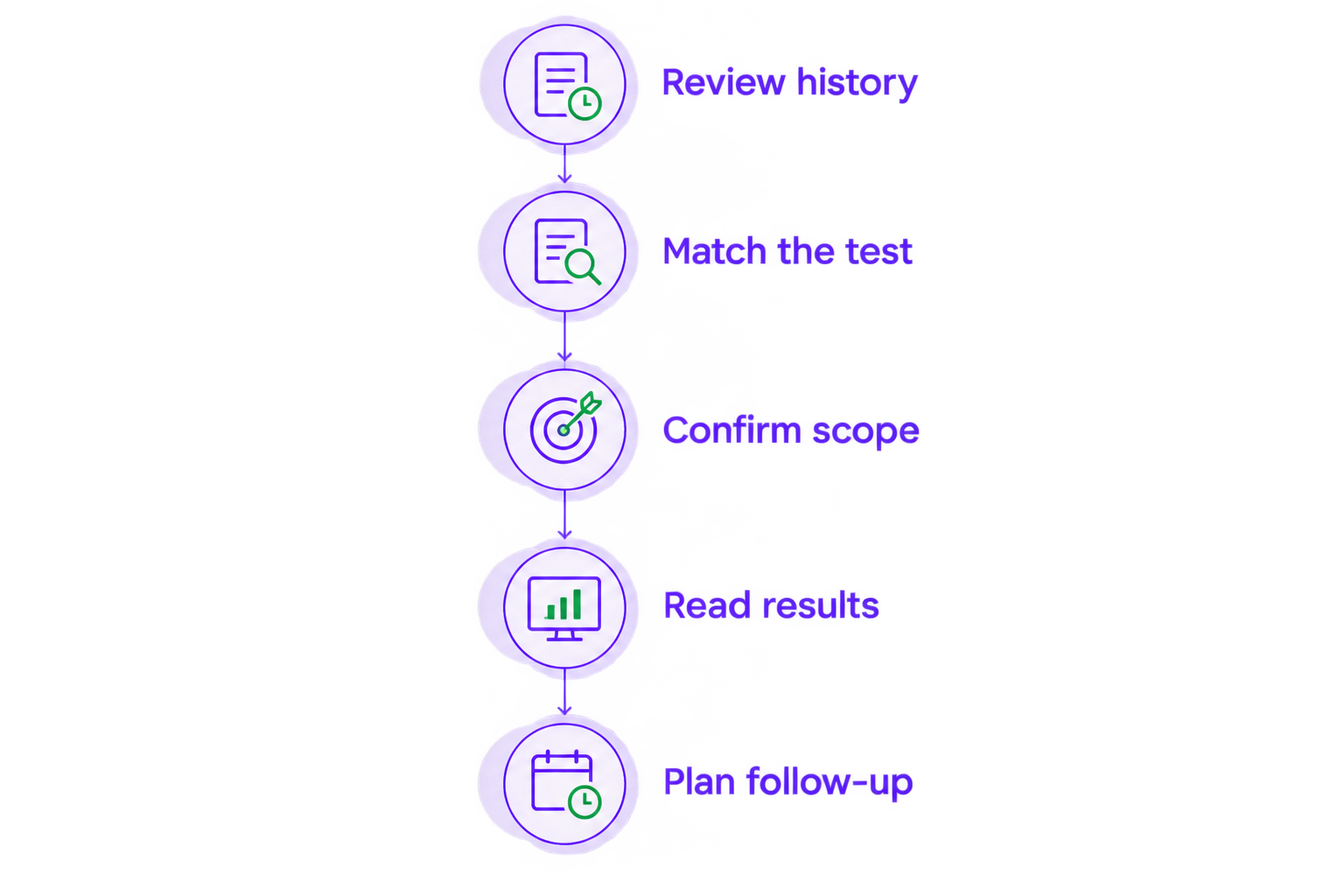
- Review history. Gather disclosures, prior inspection reports, treatment records and available repair documentation. Note gaps without treating missing paperwork as proof of a defect.
- Match the test. State the question in plain language: indoor radon, pipe condition, insect evidence, suspect materials or moisture source.
- Confirm scope. Ask about access, sampling locations, excluded areas, report contents and the expected reporting schedule.
- Read results. Separate measured results from visual observations, interpretations and recommendations for additional evaluation.
- Plan follow-up. Decide which findings need clarification, specialist evaluation or repair discussions before your contractual deadline.
For each requested test, ask who performs it and who interprets the result. Also ask what happens if access is blocked or a sample cannot be collected as planned. These details determine whether the report will answer your purchase question.
Mycityhomeinspector offers radon, mold, sewer scope and termite testing alongside its inspection services. Confirm your requested combination and any separately arranged assessments rather than assuming a single appointment covers everything.
Which specialty tests should you choose?
For an undecided Chattanooga buyer in 2026, start with a home inspection and radon testing, then resolve sewer-line and termite questions from the property's history and findings. Add lead or asbestos assessment before planned disturbance of suspect materials. Use mold assessment to investigate a defined moisture concern, not to obtain a blanket clean-house label.
The same question-based approach applies when you compare inspection needs in Knoxville, Nashville or Atlanta. Do not transfer a result, requirement or scope from one property to another simply because both houses are older.
FAQ
What are the best specialty tests for an older home in Chattanooga?
Start with radon testing, then consider a sewer scope and termite inspection around the property's history and findings. Lead, asbestos and mold assessment belong in the plan when materials, renovation work or moisture concerns create a specific question.
Does a regular home inspection include radon and sewer testing?
Do not assume radon testing or a sewer scope is included in a general home inspection. Confirm each service, its scope and its reporting arrangements before the appointment.
Should I test an older house for mold even if I cannot see any?
Choose mold assessment around a defined concern, such as water-damage history, unexplained dampness or a musty odor. Ask how any proposed sampling will help answer that concern and guide the next step.
What radon result requires action?
EPA recommends fixing a home when the radon level is 4 pCi/L or higher. Follow the applicable testing and confirmation guidance when interpreting a purchase-related result.
Does every older house need lead and asbestos testing?
Age alone does not establish the assessment scope. Discuss the materials present, their condition and your renovation plans with an appropriately qualified assessor before disturbing suspect materials.
Can a sewer scope tell me whether a house has any plumbing problems?
No. A sewer scope documents visible conditions inside the pipe sections reached by the camera; it does not evaluate every supply pipe, fixture, concealed connection or wastewater-system component.
Can Mycityhomeinspector arrange specialty testing with a home inspection?
Mycityhomeinspector offers home inspections and specialty services including radon, mold, sewer scope and termite testing. Confirm the services, access needs and reporting schedule for your property; do not assume lead or asbestos assessment is included.
One last thing
An uninspected area is not a passed area. When you read a specialty report, look for access limitations before focusing on the summary. A blocked sewer camera, concealed framing or an unassessed material leaves a question open—and that unresolved question belongs in your purchase plan.
Related guides
Protect Your Home. Inside and Out.
Plan a professional inspection and get clearer information about the property you own, are buying, or are preparing to sell.