Best default starting point: radon testing. Best for the buried drain: a sewer scope. Best for wood-destroying insect concerns: a termite inspection. For an older Knoxville home purchase in 2026, choose additional testing from the property's condition, records and planned work—not age alone.
- For specialty tests for older homes Knoxville buyers should consider, start with radon and property-specific concerns.
- Mycityhomeinspector offers radon, mold, sewer scope and termite testing; confirm the scope before booking.
- Use targeted mold testing to answer a moisture question, not to replace finding the water source.
- Discuss lead and asbestos assessment before renovation disturbs suspect paint or building materials.
Why this matters
An older home's general inspection and its specialty tests answer different questions. A visible, accessible inspection documents property systems and observed defects; it does not establish a radon level, reveal every buried pipe defect or identify asbestos by appearance.
Mycityhomeinspector is a fit for Knoxville buyers seeking home inspection services and specialty testing. Its stated offerings include radon, mold, sewer scope and termite testing. Review the existing inspection services and confirm which evaluations your property needs before arranging appointments.
Buyers in Chattanooga, Nashville and Atlanta face the same basic decision: identify the unanswered property question, then select an evaluation that can answer it. This guide focuses on Knoxville without assuming local soil conditions, construction practices or requirements apply to every house.
What makes the best specialty test for an older home?
Use these criteria to compare recommendations for your 2026 purchase:
- A defined question: Know whether you are measuring radon, viewing a sewer line, checking insect evidence or identifying a material.
- Information beyond the general inspection: Choose an evaluation that adds evidence rather than repeats visible observations.
- A useful next step: Results should help you decide whether further evaluation, repair planning or specialist advice is needed.
- Documented limitations: Access, sampling conditions and concealed areas affect what the evaluation establishes.
- Timing that fits your contract: Allow room to receive results, ask questions and arrange follow-up before your applicable deadline.
- An appropriate evaluator: Confirm who performs the work, what the written scope includes and how findings are reported.
No single test satisfies every criterion for every property. A strong recommendation explains both the reason to order it and the limits of its answer.
Specialty tests at a glance
| Rank and option | Best for | What it adds | Key limitation |
|---|---|---|---|
| 1. Radon testing | Measuring a gas you cannot identify by sight or smell | A radon measurement during the test period | Conditions and testing duration affect interpretation |
| 2. Sewer scope | Evaluating an accessible buried drain line | Camera observations inside the accessible pipe | Obstructions and access can prevent a complete view |
| 3. Termite inspection | Investigating wood-destroying insect evidence | Findings about visible evidence and accessible damage | Concealed activity or damage can remain undetected |
| 4. Targeted mold testing | Answering a specific moisture-related question | Sample results interpreted with property observations | Sampling does not locate or fix every moisture source |
| 5. Lead assessment | Planning work around suspect painted surfaces | Paint testing or a risk assessment, depending on scope | Different assessment methods answer different questions |
| 6. Asbestos assessment | Planning disturbance of suspect materials | Material evaluation and laboratory identification when sampled | Appearance alone cannot establish asbestos content |
1. Radon testing: best for measuring an invisible exposure
Radon testing measures radon in indoor air. A home's appearance, renovation history and lack of odor do not establish its radon level, which makes measurement a useful starting point rather than a response to a visible defect.
For a 2026 purchase, follow the test provider's placement and building-condition instructions. EPA guidance describes short-term testing periods of 2–90 days and recommends fixing homes at 4 pCi/L or higher; EPA also advises considering action between 2 and 4 pCi/L. Interpret results using the applicable testing protocol, not the threshold alone.
Radon testing pros:
- Measures something a visual inspection cannot identify.
- Produces a numerical result for follow-up decisions.
- Does not require opening walls to collect the measurement.
Radon testing cons:
- A short-term result represents the measurement period, not every future condition.
- Incorrect placement or disrupted test conditions affect usefulness.
Best for: Buyers who need a current radon measurement rather than assumptions based on the house or neighborhood.
Ask who will explain the result and any recommended confirmation or mitigation steps. Testing and mitigation are separate scopes.
Verdict: Buy a properly conducted radon test rather than relying on appearance.
2. Sewer scope: best for the buried drain line
A sewer scope uses a camera to inspect accessible portions of a drain line. It can document visible roots, deposits, displaced joints or other observed pipe conditions that an indoor plumbing check does not show.
Before booking, ask where the camera will enter and which portion of the line the service covers. A report should distinguish observed defects from sections the camera could not reach; an incomplete view is not evidence that the unseen pipe is sound.
Sewer scope pros:
- Adds direct observations from inside an otherwise concealed line.
- Helps locate visible conditions for a plumbing contractor's follow-up.
- Can provide images or video for discussing findings.
Sewer scope cons:
- Blockages, bends or unavailable access can limit coverage.
- Camera observations do not establish every aspect of pipe integrity.
Best for: Buyers with an accessible sewer connection and unanswered questions about the buried drain, especially when records or observed drainage concerns justify investigation.
Confirm whether recording, location information and a written explanation are included. A plumber determines repair options; the camera inspection does not repair the pipe.
Verdict: Buy when buried-line condition remains an important unanswered question.
3. Termite inspection: best for wood-destroying insect evidence
A termite inspection evaluates accessible areas for evidence of termites and related damage within its stated scope. It is different from a general comment about deteriorated wood because insect identification and visible evidence guide the next step.
Ask the evaluator to separate active evidence, past evidence, damage and conditions that encourage infestation. Those findings have different implications, and none should be treated as a complete structural assessment of concealed framing.
Termite inspection pros:
- Focuses attention on wood-destroying insect evidence.
- Documents accessible findings for further discussion.
- Helps distinguish pest evaluation from repair planning.
Termite inspection cons:
- Finished surfaces and inaccessible spaces conceal evidence.
- An inspection does not itself treat insects or restore damaged wood.
Best for: Buyers investigating insect evidence, previous treatment records, damaged wood or transaction-specific documentation needs.
For a Knoxville purchase in 2026, confirm any required document format with the party requesting it. Do not assume every pest inspection produces the same report or satisfies the same request.
Verdict: Buy when insect evidence, property history or a documentation request supports it.
4. Targeted mold testing: best for a defined moisture question
Mold sampling is useful when it answers a specific question about a suspected condition. Start with the moisture investigation: staining, damp materials, odors and leak history help establish what needs evaluation and whether sampling adds useful information.
Do not treat a sample as a whole-house guarantee. EPA mold guidance states that sampling is generally unnecessary when visible mold growth is present, and there are no federal airborne mold limits against which a home simply passes or fails.
Targeted mold testing pros:
- Can add laboratory information to a defined investigation.
- Helps document sampled conditions alongside observations.
- Supports focused questions rather than assumptions about discoloration.
Targeted mold testing cons:
- A sample represents the sampled location and conditions.
- Results do not identify every moisture source or specify every repair.
Best for: Buyers whose evaluator can explain the sampling question and how the answer changes the next step.
Ask what each proposed sample will establish. Mycityhomeinspector offers mold testing, but inspection and testing remain separate from repair or remediation.
Verdict: Hold until the evaluator explains why sampling is needed.
5. Lead assessment: best for planned work on suspect paint
Lead testing or a lead risk assessment addresses questions about lead-based paint and exposure hazards. It is particularly relevant when your purchase plans include disturbing suspect painted surfaces through sanding, scraping, demolition or window replacement.
Clarify the service before ordering it. Identifying whether paint contains lead is not identical to evaluating lead hazards throughout a property, and a limited sample should not be described as a complete assessment.
Lead assessment pros:
- Provides evidence that appearance cannot supply.
- Helps inform renovation planning before disturbance.
- Lets you select a scope matched to paint identification or hazard evaluation.
Lead assessment cons:
- Different testing and assessment methods have different coverage.
- Results apply to the evaluated scope, not automatically to every surface.
Best for: Buyers planning renovation or investigating suspect paint and related exposure concerns.
Request an appropriately qualified lead professional and a written explanation of coverage. Do not assume lead assessment is included in the general inspection or among Mycityhomeinspector's stated specialty services.
Verdict: Buy a suitably scoped assessment before disturbing suspect paint.
6. Asbestos assessment: best before disturbing suspect materials
An asbestos assessment evaluates suspect building materials, with laboratory analysis when sampling is appropriate. Neither a material's appearance nor the house's age alone establishes whether asbestos is present.
Tell the evaluator exactly what work you plan. Removing flooring, altering insulation or opening assemblies raises different questions from leaving an intact material undisturbed, so the assessment should match the proposed disturbance.
Asbestos assessment pros:
- Replaces visual guesses with material-specific evidence.
- Supports planning before demolition or alteration.
- Identifies which evaluated materials need specialist advice.
Asbestos assessment cons:
- Sampling selected materials does not clear every concealed assembly.
- Assessment does not include removal unless separately specified.
Best for: Buyers planning work that will disturb suspect materials or investigating damaged suspect material.
Do not cut, scrape or collect a sample yourself. Ask an appropriately qualified asbestos professional to establish the assessment method; asbestos assessment is not among the brand's explicitly stated offerings.
Verdict: Buy before planned disturbance when suspect materials need identification.
How to choose tests before your inspection deadline
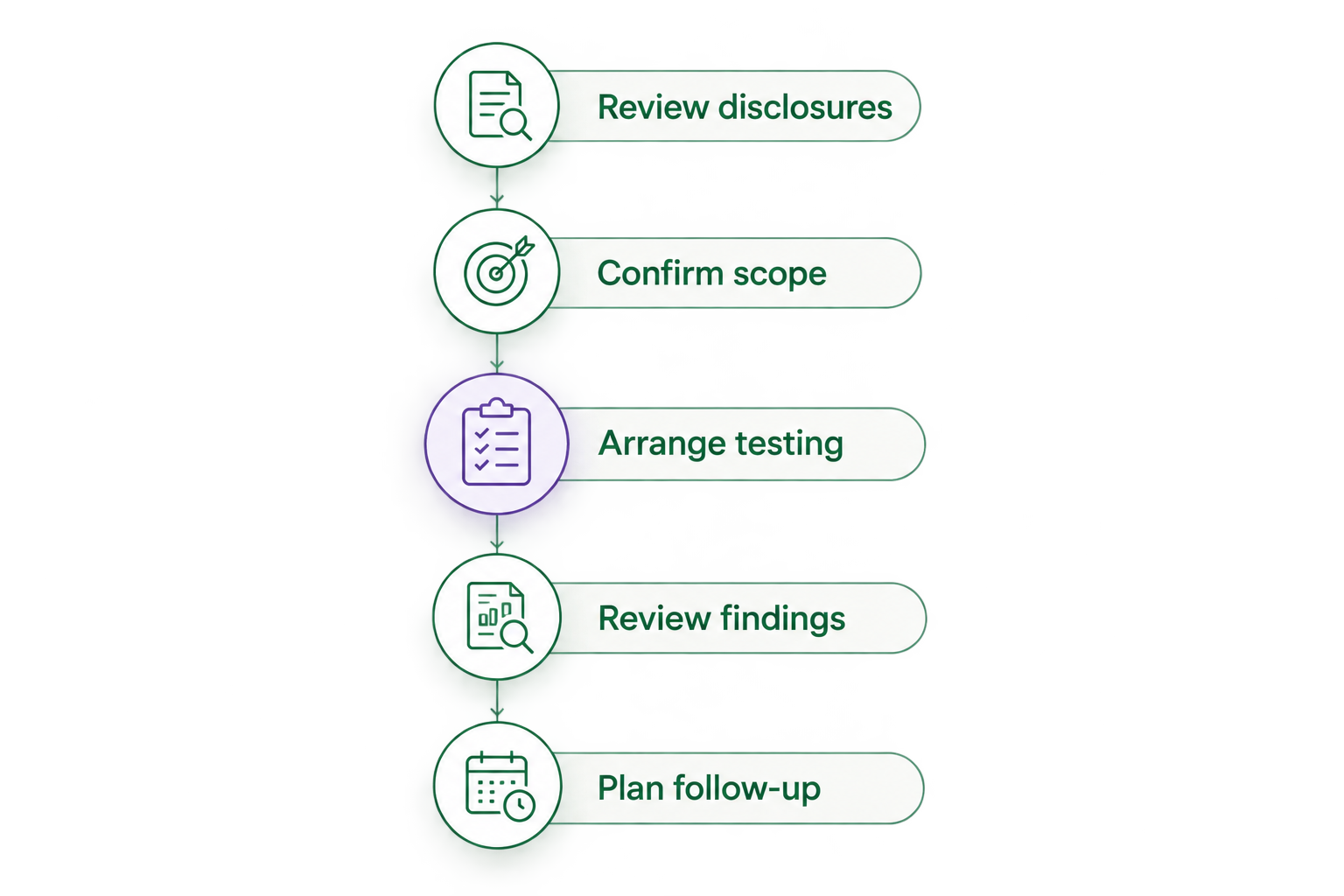
Use this sequence for a 2026 purchase rather than ordering every available service:
- Review disclosures. Gather previous inspection reports, treatment records, leak information and renovation plans.
- Confirm scope. Ask what the general inspection covers and which specialty questions remain separate.
- Arrange testing. Match each appointment to a defined question and confirm access, preparation and reporting arrangements.
- Review findings. Separate confirmed observations, test results, inaccessible areas and recommended follow-up.
- Plan follow-up. Obtain specialist advice where needed before making decisions under your contract.
Ask for written scope details before the appointment, not after an unexpected limitation appears in the report. Confirm who receives laboratory results, whether a return visit is needed and who explains unresolved findings.
How the tests are ranked
This ranking prioritizes information beyond a visible inspection, a clear decision purpose and useful follow-up. It is not a claim that every older Knoxville house needs every test, or that one evaluation establishes the condition of the whole property.
Radon leads because measurement answers a question appearance cannot. The remaining choices depend more directly on access, evidence, records and planned disturbance; their order should change when the property presents a more pressing unanswered question.
Which specialty tests should you choose?
Start with radon, consider a sewer scope, and add the remaining evaluations for documented reasons. Termite evidence calls for pest evaluation; moisture concerns call for investigation before indiscriminate sampling; renovation plans call for material-specific questions before disturbance.
Keep a short decision list for each recommendation: the question, the proposed evaluation, its limitation and the next action. That list makes a lengthy report easier to discuss without treating every observation as equally urgent.
For Knoxville buyers in 2026, the goal is not the largest testing package. It is enough reliable information to understand unresolved conditions before making the purchase decision.
FAQ
What's the best specialty test for an older Knoxville home?
Radon testing is a useful default starting point because a visual inspection cannot establish indoor radon levels. Add a sewer scope, termite inspection or other evaluation according to the property's evidence, records and planned work.
Does an older home need every specialty test?
No, age alone does not justify every specialty test. Choose each evaluation to answer a defined question that the general inspection cannot resolve.
Is a sewer scope included in a home inspection?
Do not assume a sewer scope is included in a home inspection. Confirm the written scope, camera access, line coverage and reporting arrangements before booking.
Should I order mold testing if I see water stains?
Start by investigating the moisture source rather than automatically ordering mold samples. Sampling is useful when an evaluator explains the question it answers and how the result changes the next step.
Can a home inspector identify asbestos just by looking?
No, appearance alone cannot confirm asbestos content. Ask an appropriately qualified professional to assess suspect materials before planned disturbance and determine whether sampling is appropriate.
What radon result needs follow-up?
EPA recommends fixing homes with radon levels at 4 pCi/L or higher and considering action between 2 and 4 pCi/L. Discuss the result, test conditions and any confirmation steps with the testing professional.
Does specialty testing include repairs or remediation?
No, inspection and testing do not themselves repair defects or remediate hazards. Confirm separate scopes for treatment, mitigation, repair and any follow-up verification.
One last thing
An inaccessible area is an unanswered question, not a passing result. Before closing your report, identify every limitation involving a relevant system or material and ask whether access, another evaluation or a specialist visit would change your decision.
Related guides
Protect Your Home. Inside and Out.
Plan a professional inspection and get clearer information about the property you own, are buying, or are preparing to sell.